Guide4 min read
What Is Mishri? A Guide to Thread Mishri and Misri Crystals
Traditional Indian rock sugar, explained: the names, the thread, the difference from table sugar, and how to use it at home.
Dhaaga Mishri
At a glance
- Mishri (also misri) is traditional Indian rock sugar, grown slowly into large crystals.
- Thread mishri, or dhaga mishri, is grown on a cotton thread over days, then separated by hand.
- It is still sugar: it dissolves slowly, but your body treats it like any other sugar.
Mishri is a traditional Indian rock sugar. It’s made by letting sugar syrup crystallise slowly into large, translucent crystals. You’ll also see it spelled misri, and in English it goes by rock sugar or rock candy. Maybe you spotted a jar of misri crystals at an Indian grocery and wondered what to do with it. This guide covers what mishri is and what sets thread-grown mishri apart, plus how to use it and where to buy the real thing in the USA.
What Is Mishri?
Mishri is crystallised sugar, grown slowly into large crystals instead of being milled into fine granules. It has been used in Indian homes for centuries to sweeten milk, finish a meal and flavour herbal preparations. It’s also sold under the name rock sugar.
The crystals dissolve slowly, so the sweetness arrives gradually rather than all at once. That’s the main reason people reach for mishri over table sugar.
Is Misri the Same as Mishri?
Yes, same thing. Misri and mishri are two spellings of the Hindi word मिश्री; the difference is transliteration, nothing more. Regional names vary too: kalkandam in Tamil, kalkandu in Malayalam. Shop labels in the US use all of these, which is why searching one spelling can miss products listed under another.
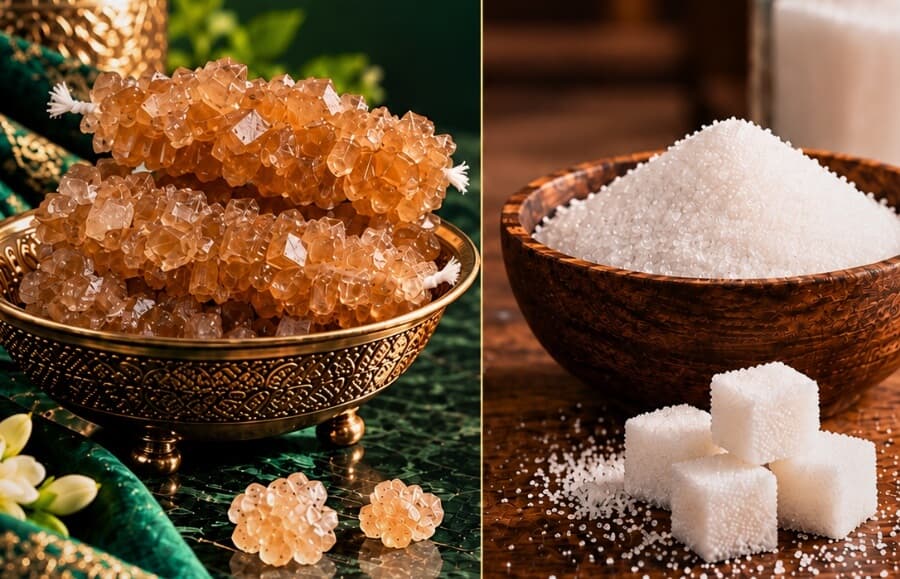
What does change is quality. Plenty of misri crystals sold today are refined sugar that’s been re-crystallised in a mould. They look tidy and uniform, and are often opaque. Real misri crystals look irregular, because nature doesn’t use moulds.
What Is Thread Mishri?
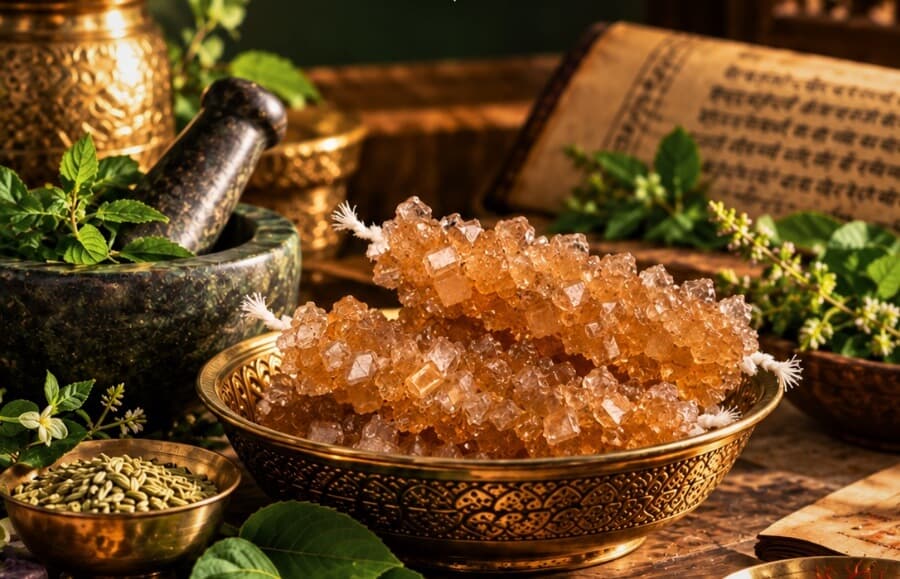
Thread mishri, also called dhaga mishri or dhage wali mishri, is mishri grown on a cotton thread. Dhaga means thread. Here’s how ours is made:
Syrup and thread
Pure cane syrup is brought to saturation and a cotton thread is suspended in it.
Nine quiet days
We leave it alone. No stirring and no shortcuts while crystals form layer by layer around the thread.
Cleaved by hand
The thread is lifted out and each formation is separated by hand along its natural facets. Never ground, never milled.
You can see the full process on our natural making page.
Thread-grown crystals take over a week to form, so they can’t be faked quickly in a factory. That makes the thread a decent authenticity check.
How Are Misri Crystals Different From Regular Sugar?
Let’s be straight about this: mishri is still sugar. It has calories, and it affects blood glucose like any other sugar. What differs is the process and the experience.
For a deeper look, read Dhaga Mishri vs Sugar: What’s the Real Difference?
How Do You Use Mishri at Home?
Four ways people actually use it:
On its own
Let one crystal dissolve slowly in your mouth.
After meals
Pair it with fennel seeds (saunf), a habit in many Indian households.
In milk or chai
Add a crystal to warm milk or tea, especially in summer.
With herbs
Sweeten preparations made with tulsi, cardamom or amla.
Mishri is regarded as cooling in Ayurveda. That comes from traditional use, not medical research, so treat it as a custom rather than a cure. What tradition says about mishri explains more.
Where Can You Buy Thread Mishri in the USA?
Right here. Our first harvest is limited to 400 boxes and arrives in November 2026, and pre-orders are open now.
- 1 ounce · jar in velvetThe Thread Taster$39
$59Pre-order - 9 ounces · wooden boxThe Heritage Box$199
$279Pre-order - 18 ounces · two jarsThe Royal Collector$349
$558Pre-order
Not sure? Start with the Thread Taster: enough to learn how slowly real thread mishri dissolves.
Standard delivery (6-12 business days) is free on orders of $199 or more and $50 below that; express delivery (2-5 business days) is $90.
We deliver to the United States, Canada, the United Kingdom, the United Arab Emirates and Australia.
DHAAGA1010% off any box, applied at checkout.
Frequently asked questions
Not meaningfully. Mishri and white sugar are both sucrose. Thread mishri skips some industrial refining and is valued in Ayurvedic tradition, but it should still be treated as sugar.
Mishri can raise blood glucose like other sugars. If you have diabetes, follow your doctor’s advice on sugar.
No. The cotton thread supports crystal growth and isn’t meant to be eaten. Separate the crystals from the thread first.
Keep them in a tightly closed glass jar in a cool, dry place, away from direct sunlight and moisture.
Close, but not identical. Rock candy is the general English term for large sugar crystals. Dhaga mishri is the Indian variety, grown on a thread and used in Ayurvedic and household traditions.