Comparison3 min read
Dhaga Mishri vs Sugar: What’s the Real Difference?
Same cane, very different journey. How thread-grown crystals differ from table sugar, and how to spot the real thing.
Dhaaga Mishri
In this article
- 01What Is the Difference Between Dhaga Mishri and Sugar?
- 02How Is Dhaga Mishri Made Compared to Regular Sugar?
- 03How Do You Tell Real Thread Mishri From Fake?
- 04Is Misri Healthier Than Sugar?
- 05How Do You Use Misri and Sugar in the Kitchen?
- 06Where Can You Buy Dhaga Mishri in the USA?
- 07Frequently asked questions
At a glance
- Dhaga mishri is grown slowly on cotton thread; table sugar is refined into fine granules.
- A real cotton thread and irregular facets are the easiest signs of the genuine article.
- Both are sucrose. Mishri changes how you eat sugar, not how your body treats it.
Dhaga mishri vs sugar sounds like an easy question. Then you stand in an Indian grocery aisle in New Jersey and find six jars labelled “misri”, and no two look alike. Some are clear and chunky. Some are chalk-white. Only one kind grows on a thread. Here’s how misri and sugar actually differ, which kind is worth paying for, and one thing to keep in mind: both are still sugar.
What Is the Difference Between Dhaga Mishri and Sugar?
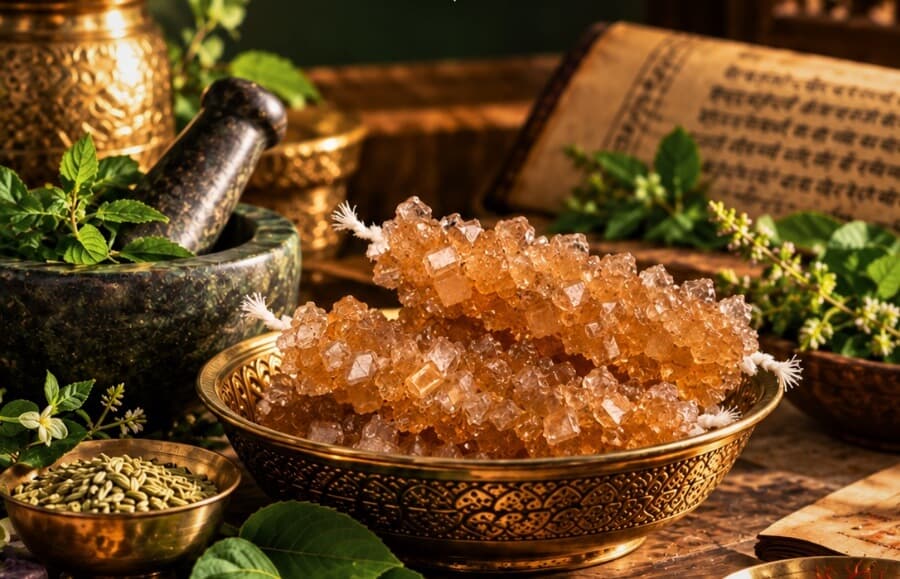
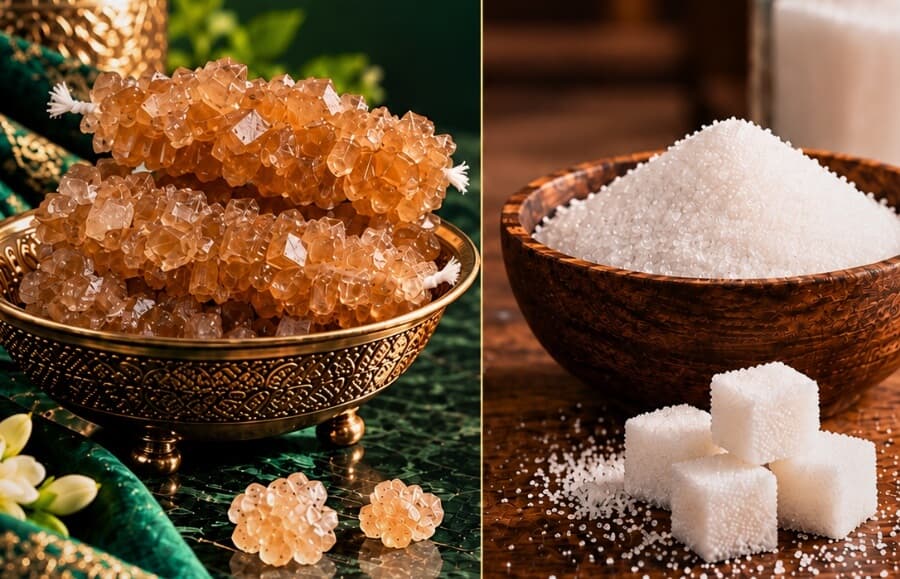
Dhaga mishri is rock sugar grown slowly on a cotton thread from sugarcane syrup, then separated by hand into large crystals. Table sugar is refined sucrose processed into fine granules. Both are sugar, but they differ in how they’re made, how they look, how fast they dissolve and how people traditionally use them.
How Is Dhaga Mishri Made Compared to Regular Sugar?
Pure cane syrup is brought to saturation. A cotton thread hangs in it. For nine days, nobody touches it. Crystals build around the thread layer by layer, and then each formation is cleaved by hand along its natural facets. Never ground, never milled.
Table sugar takes a different road: industrial purification, crystallisation and drying, ending in small, even granules.
“Same plant, very different journey.”
You can see our full process in how the crystal is made.
How Do You Tell Real Thread Mishri From Fake?
This is the part most listings skip. A lot of “misri” is refined sugar re-crystallised into chunks. It looks like rock sugar, but it’s sugar wearing a costume.
Dhage wali mishri, meaning mishri with thread, is easier to check. Look for these:
- A real cotton thread running through the crystals
- Irregular, naturally formed facets rather than perfectly uniform pieces
- An ingredient list that says sugarcane syrup and nothing else
- A seller who can explain the process without hand-waving
Our comparison of Dhaaga Mishri, regular mishri and refined sugar lays this out side by side.
Is Misri Healthier Than Sugar?
Straight answer: not in a way that changes how your body treats it. Mishri is sucrose. It raises blood glucose like any sugar.
What it has is tradition. In Ayurveda, mishri is regarded as cooling and has long been used to sweeten herbal preparations. Those are traditional uses, not medical claims. The slow-dissolving crystal does change how you eat it: a single crystal after dinner is a different habit from three spoonfuls in tea.
How Do You Use Misri and Sugar in the Kitchen?
Misri and sugar aren’t interchangeable for every job.
Sugar wins in baking
Fine granules cream with butter and dissolve evenly in a batter.
Mishri wins for slow sweetness
Stirred into warm milk, or melted into a tulsi-and-cardamom herbal drink.
After a meal
One crystal next to a pinch of fennel seeds (saunf).
In tea
Crush it first so it dissolves faster, then give it a minute.
Read more about the traditional uses of mishri.
Where Can You Buy Dhaga Mishri in the USA?
We’re taking pre-orders for our first harvest, expected in November 2026. It’s limited to 400 boxes, each crystal grown on thread and cleaved by hand.
- 1 ounce · jar in velvetThe Thread Taster$39
$59Pre-order - 9 ounces · wooden boxThe Heritage Box$199
$279Pre-order - 18 ounces · two jarsThe Royal Collector$349
$558Pre-order
The Thread Taster is the easy way to find out how slowly it dissolves; the Heritage Box makes a fine gift.
Standard delivery (6-12 business days) is free on orders of $199 or more and $50 below that; express delivery (2-5 business days) is $90.
We deliver to the United States, Canada, the United Kingdom, the United Arab Emirates and Australia.
DHAAGA1010% off any box, applied at checkout.
Frequently asked questions
Yes. Both mean mishri with thread. The crystals form around a cotton thread, which is how you tell traditional rock sugar from re-crystallised sugar.
Start by taste and adjust. Large crystals dissolve slowly, so crush them for hot drinks and give them a minute. For baking, regular sugar is the better tool.
Misri is still sugar and can raise blood glucose. People with diabetes should follow their healthcare professional’s advice about any sugar.
No. The thread is only a surface for the crystals to grow on. Separate the crystals from it before eating.
Keep it in a tightly closed glass jar in a cool, dry place, away from sunlight and moisture. Check the best-before date on the packaging.