Tradition4 min read
Mishri Benefits: What Tradition Says About This Ayurvedic Sweetener
The grounded version: what Ayurveda and Indian households say about mishri, what they don’t, and how to choose a good one.
Dhaaga Mishri
In this article
- 01What Are Mishri Benefits, Exactly?
- 02Why Is Mishri Called an Ayurvedic Sweetener?
- 03How Do People Traditionally Use Mishri?
- 04Is Mishri Healthier Than Refined Sugar?
- 05What Makes Thread Mishri (Dhaga Mishri) Different?
- 06Who Should Limit or Skip Mishri?
- 07Where Can You Buy Authentic Mishri in the USA?
- 08Frequently asked questions
At a glance
- Mishri’s benefits come from traditional use, not clinical trials.
- Ayurveda calls it sheeta (cooling) and uses it as anupana, a carrier for herbs.
- It is still sugar: the practical win is that a slow crystal usually means using less.
You’ve probably seen a small bowl of pale crystals by the bill at an Indian restaurant, or a jar of them on a relative’s kitchen shelf. That’s mishri. The talk around mishri benefits is loud and often exaggerated, so here’s the grounded version. It covers what tradition says, what it doesn’t, and how to choose a good Ayurvedic sweetener in the USA.
What Are Mishri Benefits, Exactly?
Mishri benefits come from traditional use, not clinical trials. In Ayurveda, mishri is valued as a cooling, gentle sweetener. Households use it to comfort the throat, to follow meals with fennel, and to sweeten milk or herbal preparations. It’s still sugar, so moderation matters.
Why Is Mishri Called an Ayurvedic Sweetener?
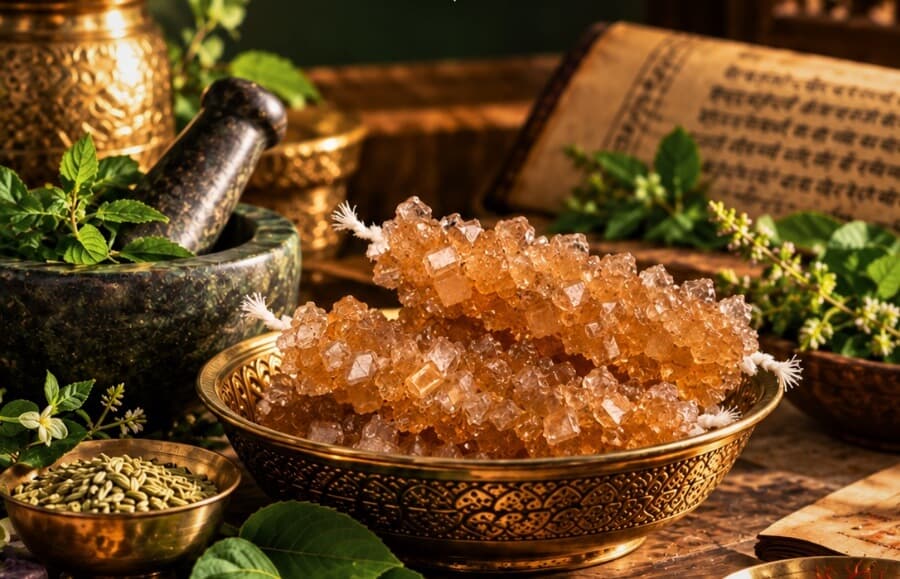
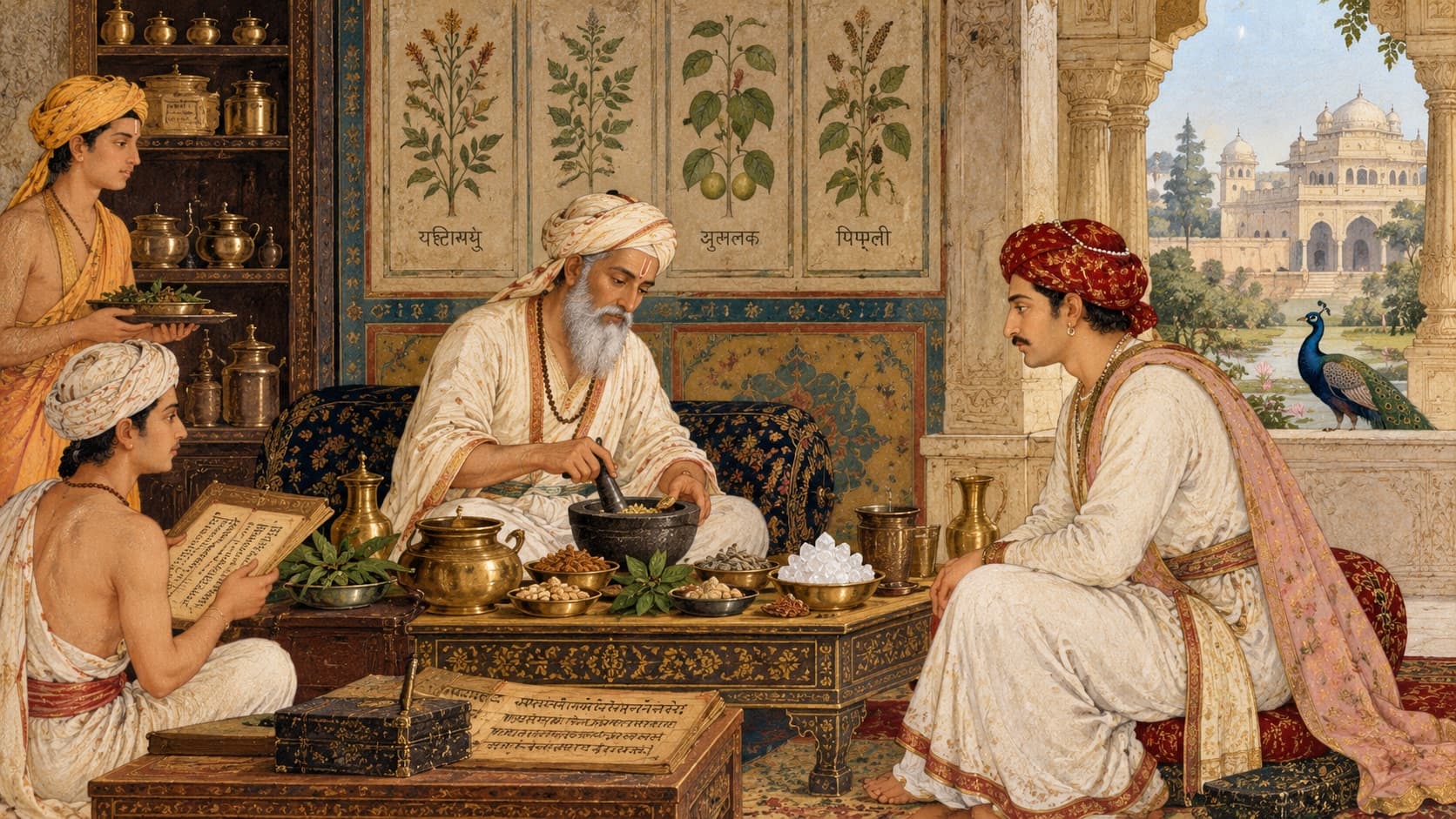
Ayurveda describes foods by their effect on the body. Mishri is regarded as sheeta, meaning cooling. That’s why it turns up in milk and summer drinks. It also serves as anupana, a carrier that sweetens herbal preparations such as tulsi, cardamom and amla.
“Refined sugar is a bulk ingredient. Mishri is closer to a condiment: something you reach for on purpose.”
How Do People Traditionally Use Mishri?
Four uses come up again and again in Indian households:
After meals
A crystal eaten with fennel seeds (saunf).
For the throat
One crystal dissolved slowly after long hours of talking or singing.
In milk
Stirred in during the hot months.
With herbs
Sweetening tulsi, cardamom or amla preparations.
The most repeated habit is a crystal handed to a child with a cough. That’s folk practice, not medicine: if a cough lingers, see a doctor. You can read more about the traditional uses of mishri on our homepage.
Is Mishri Healthier Than Refined Sugar?
Honestly, not by much. Mishri is sucrose, and it raises blood sugar like any other sugar.
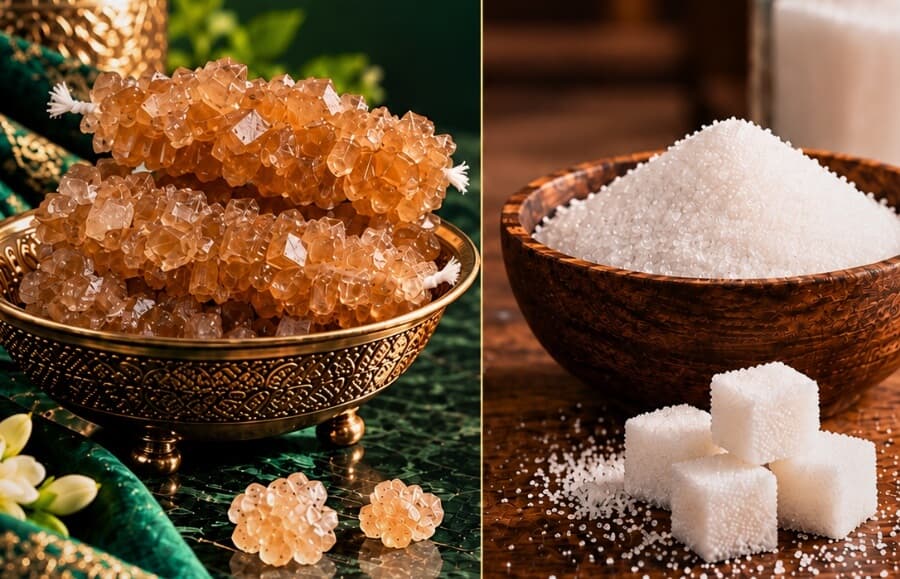
The real difference is processing and form. Large crystals dissolve slowly, so most people use less, and eating less sugar is the practical win. There’s no magic in the crystal.
Quality varies, though. Some mishri is made from refined sugar, khaand or blended sources. Check how it’s made before you buy. Our guide to dhaga mishri vs sugar shows what to look for.
What Makes Thread Mishri (Dhaga Mishri) Different?
Our thread mishri, also sold as dhaga mishri or dhage wali mishri, is grown rather than set in a tray.
Suspended in syrup
A cotton thread hangs in saturated cane syrup.
Grown in the dark
Over nine days, crystals form around it layer by layer, with no stirring.
Cleaved, never milled
The crystals are separated by hand along their natural facets.
Our ingredient list is cane syrup and the thread, which you don’t eat. Here’s the full process of how the crystal is made.
Who Should Limit or Skip Mishri?
Where Can You Buy Authentic Mishri in the USA?
Most US grocery shelves stock loose rock sugar of unclear origin. Look for a stated method and a short ingredient list.
Our first harvest is limited to 400 boxes and arrives in November 2026, so everything is pre-order for now.
- 1 ounce · jar in velvetThe Thread Taster$39
$59Pre-order - 9 ounces · wooden boxThe Heritage Box$199
$279Pre-order - 18 ounces · two jarsThe Royal Collector$349
$558Pre-order
The Thread Taster is a low-risk way to try it; the Heritage Box is our most recommended.
Standard delivery (6-12 business days) is free on orders of $199 or more and $50 below that; express delivery (2-5 business days) is $90.
We deliver to the United States, Canada, the United Kingdom, the United Arab Emirates and Australia.
DHAAGA1010% off any box, applied at checkout.
Frequently asked questions
Traditionally, mishri is used to sweeten milk and herbal preparations, to soothe the throat, and to follow meals alongside fennel. These are traditional uses, not medical claims.
Not always. Dhaga mishri grows on a cotton thread, and the crystals are separated by hand. Regular mishri can be made by other methods and from other sugar sources.
Yes. Drop a crystal into a hot cup and stir. It dissolves more slowly than granulated sugar, so give it a minute.
Mishri can raise blood glucose like other sugars. Follow your healthcare professional’s advice about sugar before adding it to your diet.
Keep it in a tightly closed glass jar, in a cool, dry place away from sunlight and moisture. Check the best-before date on the packaging.
Yes. We deliver to the United States, Canada, the United Kingdom, the United Arab Emirates and Australia, and standard delivery is free on orders of $199 or more.